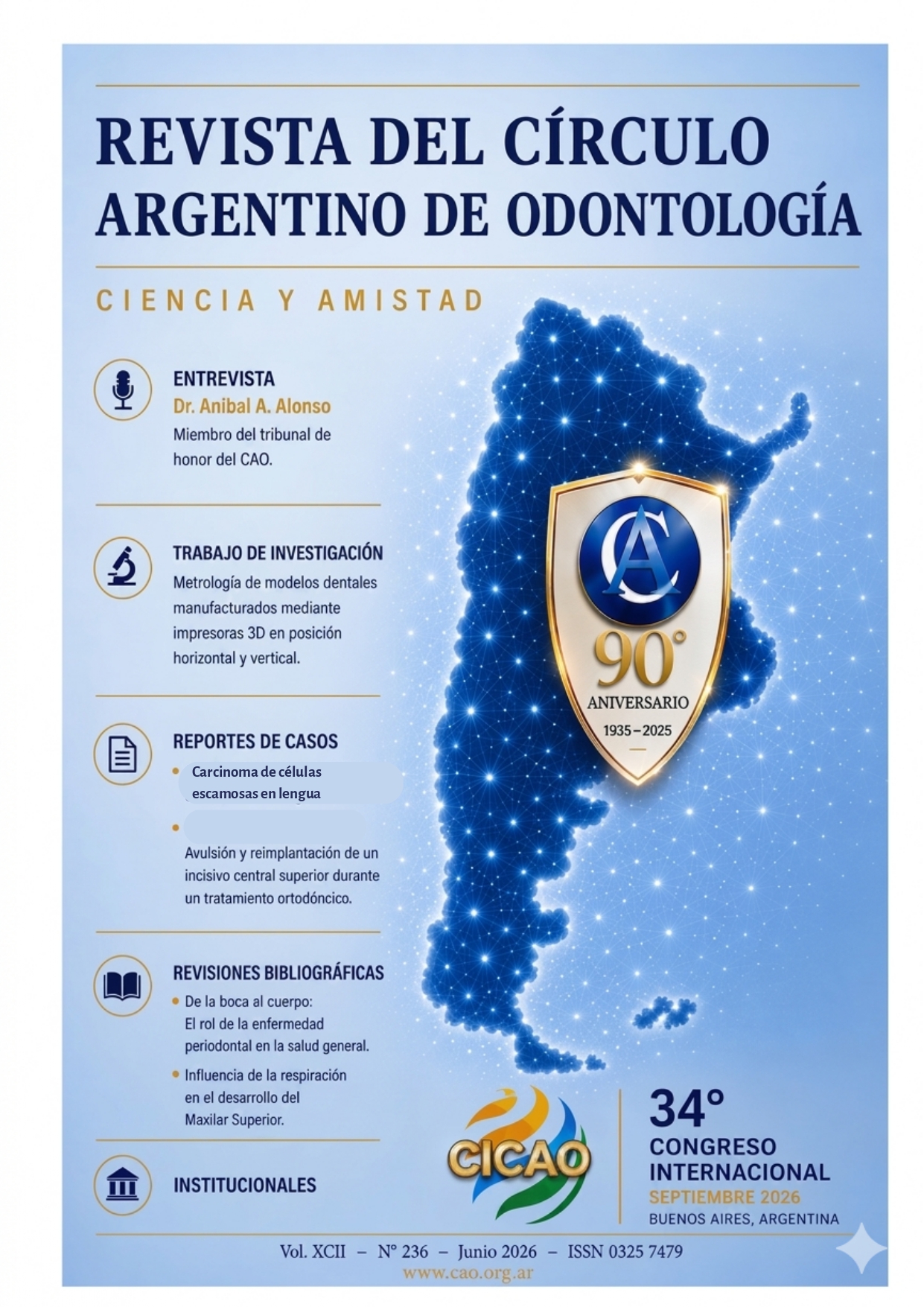
Influencia de la respiración en el desarrollo del maxilar superior
DOI:
https://doi.org/10.66549/skzg7r87Keywords:
breathing, palate, tongueAbstract
Breathing is a vital process; it can affect craniofacial development, particularly that of the maxilla. This literature review analyzes the relationship between breathing patterns and maxillary development. Numerous studies have shown that chronic mouth breathing in early life is associated with morphological alterations of the maxilla, such as narrow palate, malocclusions, and lingual postural changes. It is concluded that early diagnosis and an interdisciplinary approach are essential to prevent structural and functional alterations.References
Harvold EP, Tomer BS, Vargervik K, Chierici G. Primate experiments on oral respiration. Am J Orthod. 1981;79(4):359-72.
Souki BQ, et al. Prevalence of malocclusion among mouth breathing children. Int J Pediatr Otorhinolaryngol. 2009;73(5):767-73.
Linder-Aronson S. Adenoids: their effect on mode of breathing and nasal airflow. Acta Otolaryngol Suppl. 1970;265:1-132.
Moss ML. The functional matrix hypothesis revisited. Am J Orthod Dentofacial Orthop. 1997;112(1):8-11.
Zambon CE, et al. Influence of breathing pattern on craniofacial development. Braz J Otorhinolaryngol. 2012;78(4):113-8.
Guimarães KC, et al. Effects of oropharyngeal exercises on obstructive sleep apnea. Am J Respir Crit Care Med. 2009;179(10):962-6.
Guilleminault C, et al. Mouth breathing: adverse effects on facial growth, health, academics, and behavior. Sleep Med Clin. 2013;8(3):437-44.
Zambrana N, Toledo González, Lopes LD. Logopedia y ortopedia maxilar en la rehabilitación oral. [Lugar de publicación no identificado]: [editor Actualidades Médico Odontológicas Latinoamérica]; [año2000 ]. p.23-6.
Robin P. Glass, MS, OTR/L, and Lynn S. Wolf, MOT, OTR/L. Volume 10, Issue 3. Incoordination of Sucking, Swallowing, and Breathing as an Etiology for Breastfeeding Difficulty.
Teresinha S.P. Lopes, Lúcia F.A.D. Moura, Maria C.M.P. Lima. Association between breastfeeding and breathing pattern in children: a sectional study. Jornal de Pediatria (Versão em Português) (Jul 2014).
Kim DK, Rhee CS, Yun PY, Kim JW. Adenotonsillar hypertrophy as a risk factor of dentofacial abnormality in Korean children. Eur Arch Otorhinolaryngol 2015;272(11):3311-6. DOI: 10.1007/s00405-014-3407-6.
Yang R, Zong T, Fu Z, Sun Y, Lu J. Effect of enlarged adenoid on tooth maxillofacial development in children. J Otolaryngol Ophthalmol Shandong Univ 2013;27(5):52-4.
Habumugisha J, Ma S, Mohamed AS, Cheng B, Zhao M, Bu W, et Al. Three-dimensional evaluation of pharyngeal airway and maxillary arch in mouth and nasal breathing children with skeletal class I and II. BMC Oral Health 2022;22:320. DOI: 10.1186/s12903-022-02355-3.
Downloads
Published
Issue
Section
License
Los artículos publicados en la Revista del Círculo Argentino de Odontología se distribuyen bajo una licencia Creative Commons Atribución-NoComercial-SinDerivadas 4.0 Internacional (CC BY-NC-ND 4.0).
Se permite compartir y redistribuir el material en cualquier medio o formato, siempre que se otorgue el crédito correspondiente a los autores y a la fuente original, se incluya un enlace a la licencia y no se realicen modificaciones del material. No se permite el uso del material con fines comerciales.
Los autores conservan los derechos de autor de sus trabajos y otorgan a la revista el derecho de primera publicación.
La licencia completa puede consultarse en:
https://creativecommons.org/licenses/by-nc-nd/4.0/